Maslow’s hierarchy is a map, not the territory
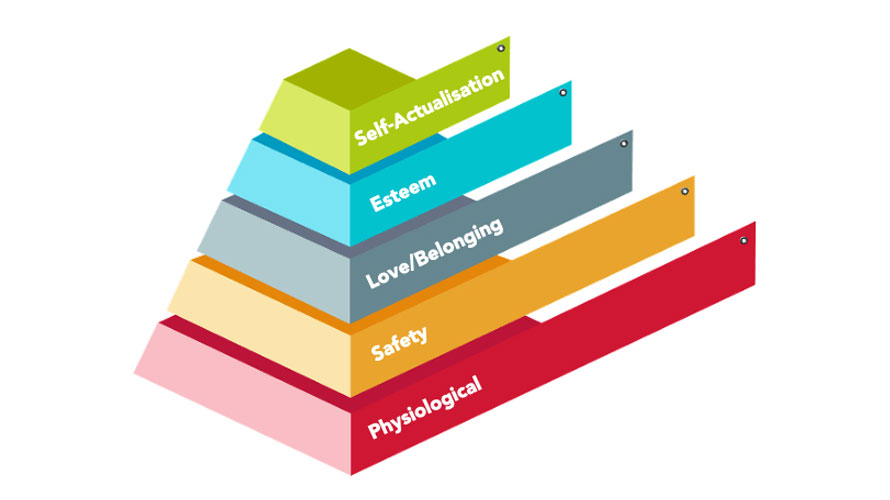
We love Maslow and his hierarchy of needs. It’s easy to understand, gives us a north star to strive for, and helps us make sense of our world. Just one problem. Our needs don’t fit neatly into that map. Where we meet one need, then the other as we climb the pyramid. Something is missing. But what?
It’s missing social connection
And then I stumbled upon this article in Psychology Today. The author, Dr Pamela B. Rutledge, suggests that what’s missing in Maslow’s hierarchy is what each of the needs have in common. They need social connection to be met.
I thought, ‘hmmm, she’s onto something here’. We’re social creatures. Of course, our needs are met with and through others.
But there are many forms of social connection. Think of all your different relationships and how they’re all different. They meet different needs at different times. Something our language fails to capture. If we don’t have the words for something, it’s hard to imagine, let alone communicate.
It’d be great if we had the words. Like the Inuit have for snow and ice. Words that draw very subtle distinctions between a very high number of characteristics.
I was going to just say, you know, like the Inuit have 50 different words for snow. But thought I’d fact-check that common expression. It turns out there are way more. According to the online Canadian encyclopedia, the 2010 publication Siku: Knowing Our Ice, presents a lexicon of sea ice terminology that includes no fewer than 93 different words! That’s a lot of variation in snow and ice. Just like the variations in our relationships, but we don’t have the words to capture them.
A map for social connection
Still, when I was doing my PhD, I wanted to capture some of the nuances in our social connections at work and the relational needs they met. I was interested in the experience of work because we spend so much time there. It matters.
As you can imagine, there’s very little out there. I ended up with what follows, after building on some wonderful work by Professor Ruthellen Josselson and others. I find it a very useful map. A great way to think about how our social connections help and hinder the extent to which we thrive at work.
When these relational needs aren’t met, we don’t thrive. Worse, unmet needs like these distract us from the work itself, what we’re employed to do.
This map isn’t nice and ordered like Maslow’s hierarchy. It’s because these needs aren’t in any order. Plus, they vary in importance between people. The only north star here is to get your needs met so that you can get on with the job and do your best work.
Here it is. It’s simply to feel:
- Safe and secure: An underlying sense of trust that someone will be there for us and won’t let us fall.
- An emotional bond: Where we feel emotionally secure in a relationship. We’re confident that the person will be consistently available and sensitively responsive when we need them.
- Passionate: Where we love what we do, it may resonate with our values, be personally meaningful, or we get a buzz out of doing it. Even better when we get those intense moments of being in ‘the zone’.
- Authentically validated: Where we feel, through the eyes of another, as valued, understood, and accepted as ourselves.
- There’s something to strive for: Where we have someone to look up to, such as a role model who gives us something to strive for and shows us what’s possible.
- Experiences are shared: This is the feeling of companionship, someone to share experiences with. It can be as simple as chatting with our colleagues about the weather. It may be unremarkable, but life feels cold and empty without them.
- You belong: Where we feel we belong in a group. It’s the context we can use to define ourselves and gives us a sense of place.
- You’re contributing to others: Where we put our own needs aside to care for and make a positive difference for others. When coming from a place of genuine care, in return we experience joy.
I say it’s simply to feel each of these, but it’s anything but easy to get it just right with people. You can go overboard or not go far enough. The idea is to get it just right. Like Goldilocks! Doing so will take you a long way with the people you lead. Just imagine how motivated and psychologically safe someone would feel with you if you helped them meet these needs at work!
It’s no surprise either that recent research reported in HBR concluded that these are now the skills that matter most for the C-suite today. People skills. This is the kind of map you’d want in your back pocket because it shows you where to find the buried treasure within yourself and the people you work with.
If you’d like to learn more about my map for social connections, I wrote an eBook called Respect in Eight. You’ll learn more about each relational need, how to recognise when you’ve Goldilocks-ed it, namely, you’ve got it just right vs too little or too much. And what to do when you inevitably miss the mark. Don’t worry, just remember, when your heart is in the right place, people are very forgiving. You’re more likely than not to get another chance with them.