Relationships at work matter. For two main reasons.
That’s why it’s smart to focus on developing more high-quality connections. The more attuned you are, the easier they are to develop.
Think of it [attunement] as operating the dial on a radio. It’s the capacity to move up and down the band as circumstances demand, locking in on what’s being transmitted, even if those signals aren’t immediately clear or obvious.
— Daniel Pink
American author
Why? Because, as a leader:
But, I bet you know this from your own experience, and as the research shows, that’s easier said than done.
Two in three (63%) employees feel their voice has been ignored in some way by their manager or employer: A third (34%) of employees would rather quit or switch teams than voice their true concerns with management.
— The Workforce Institute at UKG (2021) The Heard and the Heard-Nots
Relationships are tricky at the best of times. Different relationships evoke different feelings. They meet different needs. They are complex and subtle. And they don’t stay still as we continuously adapt to each other.
Plus as a leader, you have a range of additional challenges such as:
I bet you can think of more. And that’s to say nothing of the extra difficult times when you’re worried about burning out and that you won’t have the energy the job demands of you. Or that underperforming staff will hold you back.
It isn’t easy, but in my experience, my biggest people challenges started to melt away (with a corresponding uptick in my performance and wellbeing) as I became more attuned.
Your journey may be like mine. I started out unaware and, over time, learned what to do. The CEO noticed. They came to me and said:
I don’t know what you’re doing, but can you teach the other Department Heads too?
I’d been able to turn around difficult underperformers into the ones you’d want on your team. I did it by focusing on becoming more attuned to them, from unaware and clueless, to clarity.
Here are the steps I took:
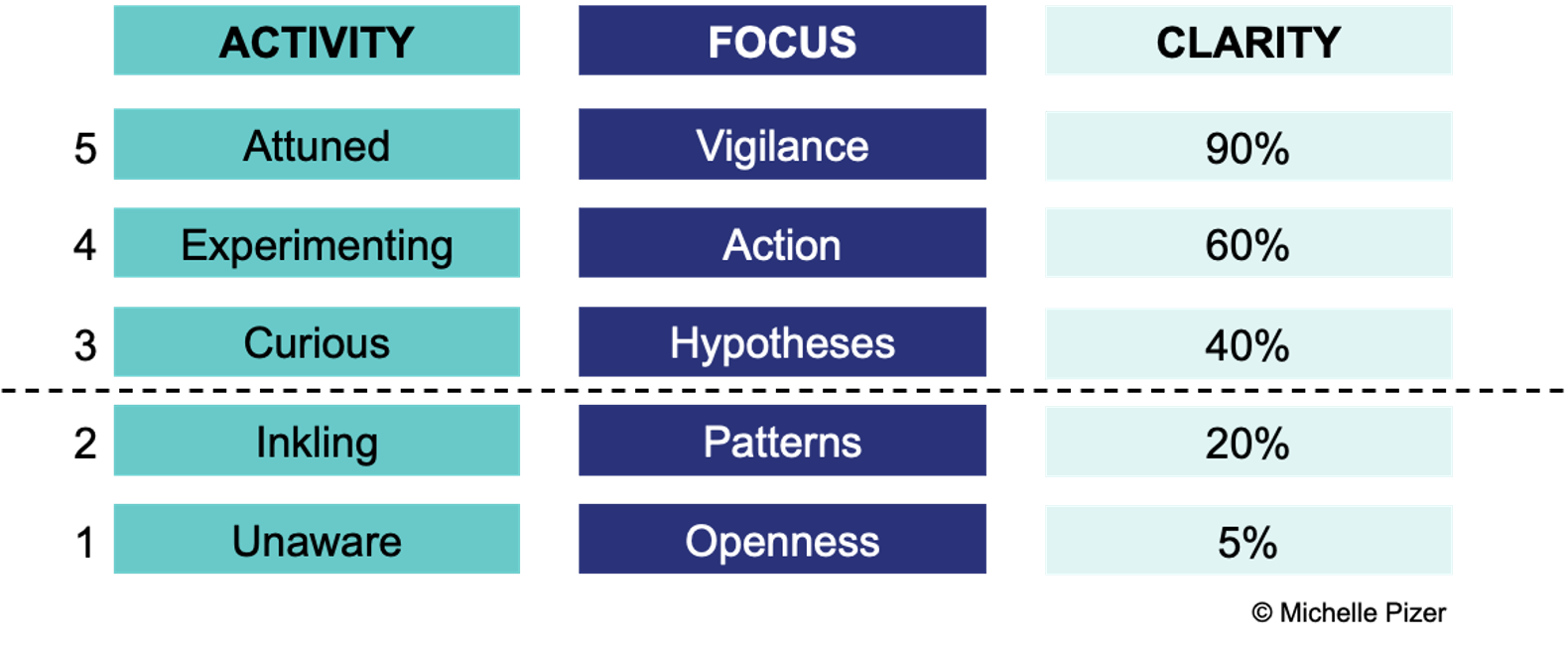
The first step is to ask yourself where you are on your attuned leadership journey. The idea is to start wherever you’re at.
Then remember you’re a person first. So, for yourself, to what extent do you feel:
Then, as a leader, to what extent are you:
If there’s room for improvement, there’s work to be done. So, ask yourself, what impact will being an attuned leader have on your performance, confidence and presence at work? How much more inspired, purposeful, and willing to collaborate will others be when you’re attuned to them?
If becoming more attuned is something you would like to work on, whether for yourself or as a leader, I’d love to help. It’s almost 2025. Start the year strong!
Schedule a time here to set up a no-nonsense, no-obligation call, where we’ll talk about how to achieve your specific goals.
Image by Franz W. from Pixabay