
Everyone wants to be part of a dream team. If only they were easy to create and maintain. Some years back I was so inspired by Maryellen, a great leader who was running successful hybrid teams before they were commonplace. She so inspired me then that I decided to repost it today. I hope you find it helpful.
The original post:
Today is a first. It’s called Tales of the Leadership Field. Featuring brilliant leaders out there in the field.
I don’t mean the ones we all know about from mainstream media. I mean us more ordinary folk.
The hidden leaders, quietly doing their brilliant work. My plan is to feature you. Yes you, my valued readers.
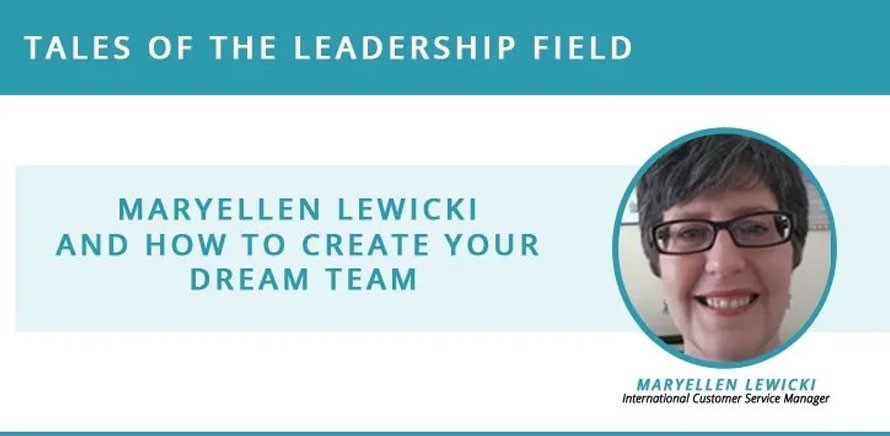
Today’s tale features Maryellen Lewicki and how to create your Dream Team.
If you have a story to share or a brilliant boss we could all learn from, then please let me know. You know who you are.
There’s no set timetable. They’ll just pop in here from time to time. Look out for them. As much as all the bad bosses out there appal us, equally we are humbled and inspired by the brilliant bosses we’ve had. People doing great work to whom we are indebted for the impact they’ve had on our career. Hopefully, we’re doing the same for others.
Create your dream team with Maryellen Lewicki.
 Maryellen Lewicki
She’s worked for the same global manufacturer for 22 years.
She started out as a Customer Service Rep, became a Supervisor, then manager. Today she’s their International Customer Service Manager, managing teams devoted to exports. There are three different sites across North America. Maryellen manages them virtually most of the time.
She’s ordinary folk. Doing very well. But still, ordinary folk. And she’s the leader who inspired me to start this new segment.
Here’s what she said to me when we spoke not so long ago:
I came to realize I have my dream team while attending your Crack the Dream Team Code series of podcasts. Each time I tuned in for another interview, I found I was checking off the boxes of what my team already looks like!
What was she doing right?
How could we all learn from her?
Who doesn’t want their own Dream Team?
To capture her Tale of the Leadership Field, I asked Maryellen a series of questions. Here are her answers.
Note: The opinions expressed here are her own and do not necessarily represent the views of her employer.
What makes your team a dream team for you?
It’s really a combination of talent, a shared vision and a passion for what we do. My team members really work together well. They support one another, share ideas and help identify for me what I can do to sustain them and help them achieve their career goals.
What are three practical steps you’d suggest for someone hoping to build their own dream team?
- First, don’t be in a hurry to hire. Take your time. Patiently approach the interview process to really consider: Is this candidate the best person for the job? Am I asking the right kinds of questions to determine this person’s values and personal goals? (Or am I asking the same old questions that generate scripted responses and shed no light on who this person really is and what they really want?)
- Collaborate with your team. True success is possible when everyone helps create the vision, when everyone’s ideas are considered, when each team member can be a part of the solution. Get them involved in creating continuous improvement, at every opportunity.
- Communicate, communicate, communicate. One thing my team tells me all the time is how much they appreciate being kept informed of company initiatives, the status of open projects and regular notification of how the company is doing. Don’t assume they are hearing about what’s happening, from others. My team tells me all the time how connected they feel to one another and how what they do matters to the company as a whole. This doesn’t happen by accident.
What are the critical factors to hiring a dream team member?
Here are some questions to ask yourself:
- Does this person exhibit a passion for what you do?
- Does he/she have the necessary skills to perform the required tasks? (For example, if Excel skills are needed, don’t rely on a resume. Test the candidate as part of the interview process.)
- Ascertain a candidate’s character and personal philosophy by asking about their response to real-life scenarios. (For example: Tell me about a time when an angry customer contacted you about a missing shipment. Describe the situation. Tell me how you resolved it. What did you do? How did you feel?)
What do you find works to keep your team inspired and motivated?
I get a great deal of satisfaction from overcoming challenges and completing projects. I absolutely love finding solutions to a presented problem.
Having said that, I have found over time it is equally satisfying to assign tasks to my staff as development opportunities, especially if the employee has shared with me their career goals and what they would like to learn more about. These opportunities are a win for both of us. They feel appreciated and valued. The more they contribute and see the value to our organization, the more inspired they become.
I also actively look for moments to express my appreciation. When someone accomplishes a difficult task, or goes out of their way to assist a customer, I will shine a light of gratitude on that individual. I like to send handwritten thank you notes. I also will elevate that person’s achievement to the wider organization. Recognition costs little, but goes a long way to nurture and sustain your team.
Your team is virtual. What do you do differently because they’re virtual?
I do a number of things to make this a successful arrangement. First, we meet weekly in a video collaboration. We can all see and interact with one another during this meeting, which helps build the relationship.
Twice yearly, we have a regional meeting in person. During these meetings we have specific projects we work on together, the final results of which have direct impact on our team effectiveness.
I hold monthly one-on-one conference calls with each team member. This is a time for the employee to discuss whatever is on his/her mind. I always keep some topics at the ready, in case we have extra time. These could be related to a customer requirement, a personal development opportunity, or work/life balance issues.
What else would be helpful for people to know about building their own dream team?
Don’t be afraid to make adjustments. Give every team member every opportunity to improve or develop the skills needed to do their job well. This may require a Performance Improvement Plan, if an individual is not quite where they need to be. Be fair, be detailed, and set a deadline to fulfil the requirements of this plan. At the end of the process you will either have a more skilled and motivated employee, or it will be clear this is not the right person for your team. You may need to part ways.
I personally know this is very tough to do, but have found it turns out to be the best decision both for the team and for the individual.
Ultimately, you need at least a “rock star” or two. These are your distributed leaders, the ones who throw themselves into whatever actions are required, who come up with the good ideas, and who lead by enthusiasm and example.
And finally, what do you find is the most challenging and best part of being a boss?
The most challenging part of being a boss is what to do when you recognize a member of your team is struggling or unhappy because he/she is not a good fit.
The best part is the opportunity to develop my people. There is nothing more satisfying than to see them grow and thrive.
They’re lucky to have you, Maryellen!
And we’re lucky you were willing to share and inspire us too.
On behalf of all the readers and myself, I’d like to thank you for your generous contribution!